Evergreens in Appalachian Folk Medicine and Magic
Writing about Spring tonics made me yearn for the warmth of the return of the Sun. As we near the 1st and 2nd of February, the holiday many of us witches, pagans and folk Catholics of the North Atlantic Isle heritage celebrate as Imbolc or Candlemass, I am thinking about what lights my flame when all feels shrouded in shadows.
These old holidays are a celebration of the Quickening of the earth and the returning of the Light in the Darkness: they are the promise of the snow drop and the Dandelion. The ever needed reminder that even when all seems hopeless in an eternal Winter, there is a promise that the blaze of the sacred bonfires will melt the ice away as our hands are clasped round it. I need the medicine of this hope and I feel it as I witness the bravery and beauty of my community and the many ways people are doing what they can to continue the fight that has been going on for so long.
As always, I find solace in the plant beings around me and their many stories. While the world appears barren, I am also finding solace in writing. I would like to begin a small series on the medicinal uses of trees from the Appalachian folk medicine and Southern Folk medicine perspective. I have been battling a long respiratory illness, so I was especially called to choose Pine as the first medicinal tree monograph, as you shall see why. I hope this brings solace to you as well.
These posts are not intended to treat or diagnose any illness and are intended for research purposes only.
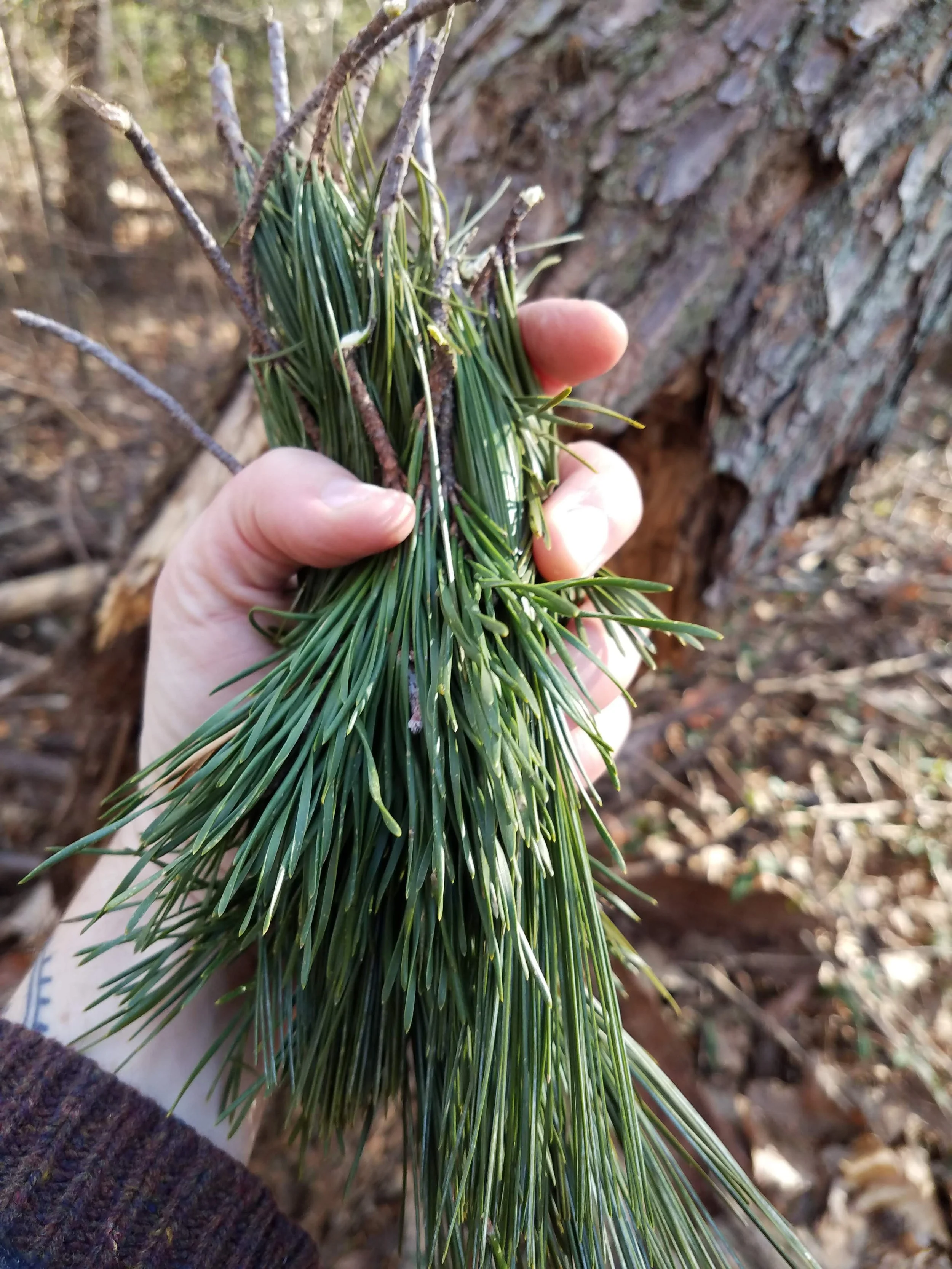
Virginia pine and white pine needles ready for tea.
The Appalachian Folk Medicinal and Magical uses of the Evergreens…
One could argue that evergreen tree medicine is one of the cornerstones of the yarb (herb) healer’s practice in Appalachia. Pines in particular are mentioned not only in old folklore books but also in popular modern use as deeply healing medicines and powerful materia magica. Every part of the evergreens I will speak of here, or cone bearing members of the Pinaceae and Cupressaceae family, provide not only effective phytochemicals, but also a spiritual medicine due to their incredible array of lovely aromas and volatile oils.
Their wood, needles, cones, roots, bark and resins are all an important part of the Appalachian folk medicinal lexicon and they make a fine place to start when learning the medicinal ways one can work with trees, for they are also easy to ID and many are abundant. What evergreens can you find in Appalachia?
White Pine (Pinus strobus)
Loblolly Pine (Pinus taeda)
Shortleaf Pine (Pinus echinata)
Black Pine (Pinus rigida)
Table-Mountain Pine (Pinus pungens)
Scrub or Virginia Pine (Pinus virginiana)
Black Spruce (Picea mariana)
Red Spruce (Picea rubra)
Hemlock (Tsuga canadensis)
Carolina Hemlock (Tsuga caroliniana)
Balsam or Frasier Fir (Abies fraseri)
And evergreens in the Cupressaceae family
Arbor vitae (Thuja occidentalis)
Red Cedar (Juniperus virginiana)
The deeper south or east you go, more cypress, long leaf pine and other types of evergreens will rise up out of the wetter, warmer, coastal areas, but for our purposes, this is a working list of evergreens in Southern Appalachia but is certainly not a all that can grow here.
Evergreens are used in all cultures’ medicine traditions wherever they grow, and Appalachia is no exception. Indigenous peoples had been working alongside the many evergreen species on Turtle Island for thousands of years before European arrival, and it is interesting to note that the largest European population which migrated to Appalachia, the English, Scottish and Irish, only have a single pine species in their native lands, the Scots Pine (Pinus sylvestris). Can you imagine meeting spruce, fir or the pines of this continent for the first time again?
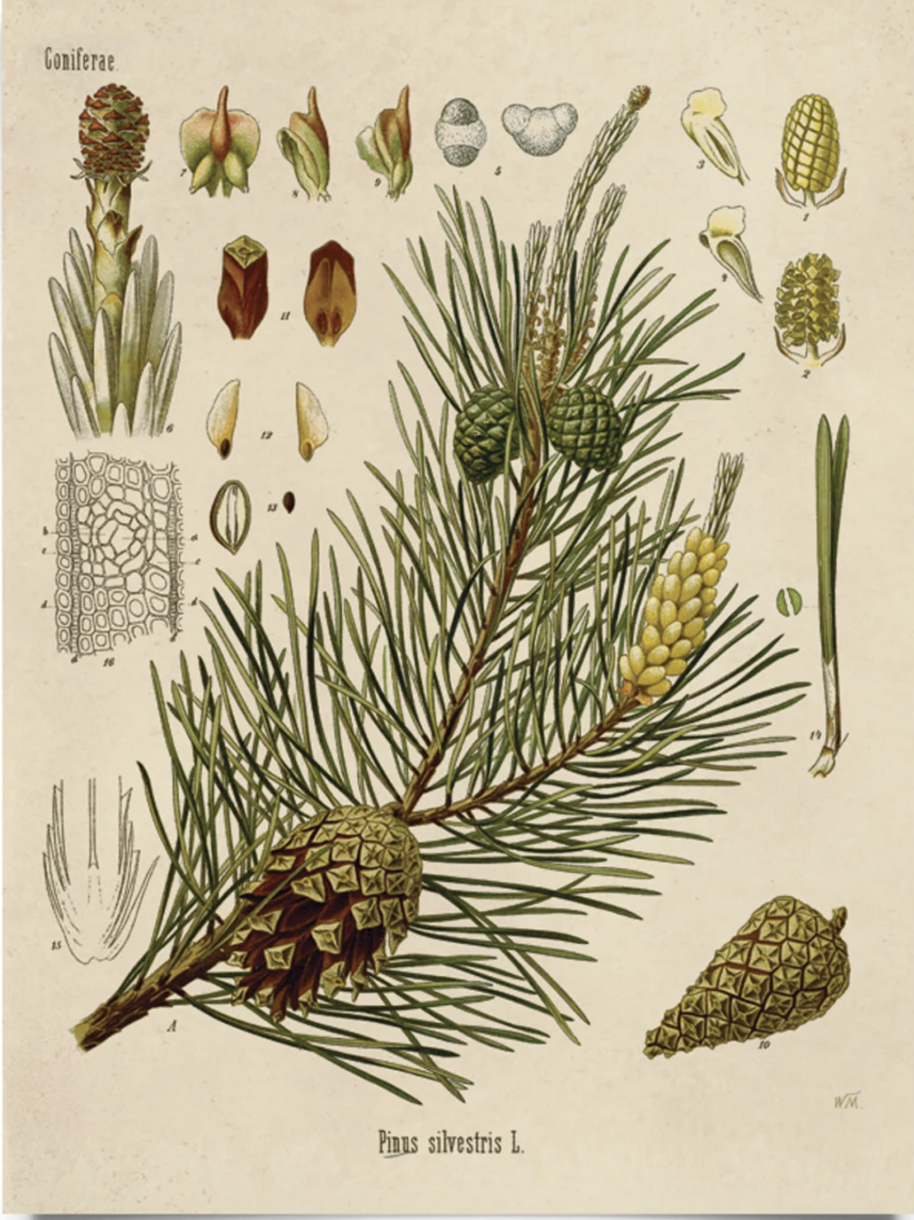
A botanical illustration of Scots pine.
While there are native evergreens to North Africa, those forcibly removed from their homelands in Western and Central Africa (who were the largest population of enslaved peoples here in Appalachia), would also have been new to the many evergreens on this bioregion. This is important to note, because it shows us that the ways in which people came to work with evergreen medicine in Appalachia was heavily influenced and guided by Indigenous medicine ways which were then augmented by the unique relationships the newcomers to this land would form with them.
The evergreens have sharp, clean, and almost citrus-like scents. You can probably summon the smell of pine or fir to your mind right now if you try. Resinous, crystalline and refreshing, the many volatile oils contained in the needles, bark and cones of the evergreens give us a sensory clue to their medicinal powers. Antiseptic, warming, drying (but occasionally moistening), nourishing, vulnerary, immune stimulating, the ways in which it was worked with historically has not changed a lot into modern herbal practice. Let us first begin in the past, with how pine was used in historical Appalachian folk medicine.
Any species listed above was worked with medicinally in some way, but I have noticed it is often the white pine that was chosen due to its abundance. White pine is often used for its mild flavor and ease of identification, as it has as many needles in a little bundle or fascicle, as it has letters in its name: 5. The tea made from the needles and twigs of this tree is a staple in folk medicine. It is called pine top tea often or pine top in Appalachian and in general in Southern folk medicine, for it is often the top most part of a little sapling that is cut and used for healing. The top of the tree is closest to heaven, making it the most healing in the Christian worldview many had in the mountains, and also syncretized with the cosmology of some Indigenous and Black worldviews as well in the region.
While turpentine made from pine is extensively used historically, I am going to focus on the whole plant parts practice of herbal healing in this essay.
Needles, twigs and bark
The tops of pines were brewed into decoctions and teas for respiratory illnesses like colds and flus, and these tops were seen as so powerfully healing, merely placing beneath a sick person’s bed was a charm against illness in itself. I speak on these things as someone who hangs the pine tops in my hope to welcome in health and chase away illness. The tops of pine were also poured over with boiling water to make an herbal steam specifically for both colds and neuralgia. Invasive mullein (Verbascum thapsus) leaves were also often mixed in as a tea particularly for coughs, as well as the aerial parts of the native rabbit tobacco or Life everlasting/ Pearly everlasting (Pseudognaphalium obtusifolium) as it is more commonly known in Black Southern folk medicine. Spruce needles were also decocted for coughs.
In a recipe gathered from Kentucky, pine bark was decocted with leaves of life everlasting (Anaphalis margaritacea), mullein leaves, and wild cherry bark (Prunus serotina) until thick and preserved with brandy for cough syrup by the spoonful. Another recipe from the area was used more as a tonic and was made from white pine bark, yellow dock (Rumex crispus), safriller (Menispermum canadense) (toxic), mayapple, ginseng, goldenseal, apple tree bark, poplar (Populus deltoides), cherry bark, sassafras bark, bear paw (unknown), peppermint, and mullein leaf. In general Southern folk medicine, meaning throughout the Southeast into the coastal regions, pine bark was often infused with other barks like sassafras, wild cherrybark, and the roots of spikenard (Aralia racemosa), bloodroot (Sanguinaria canadensis), and buds of balm of gilead (Balm a-gilly is how I most often hear it called locally) (Populus balsamifera) with honey as a stimulating expectorant for phlegmy coughs.
Sometimes ginger would also be added for coughs as well, despite not being a native plant, Appalachians had access to a wide variety of far away spices and herbs at a high cost and ginger is often found in cures. Pine needle tea was not just used for respiratory purposes but also for bowel troubles as well. Spruce (Picea spp.) needles and twigs were also decocted and made into fermented low alcohol beers which were also used medicinally for respiratory illnesses.
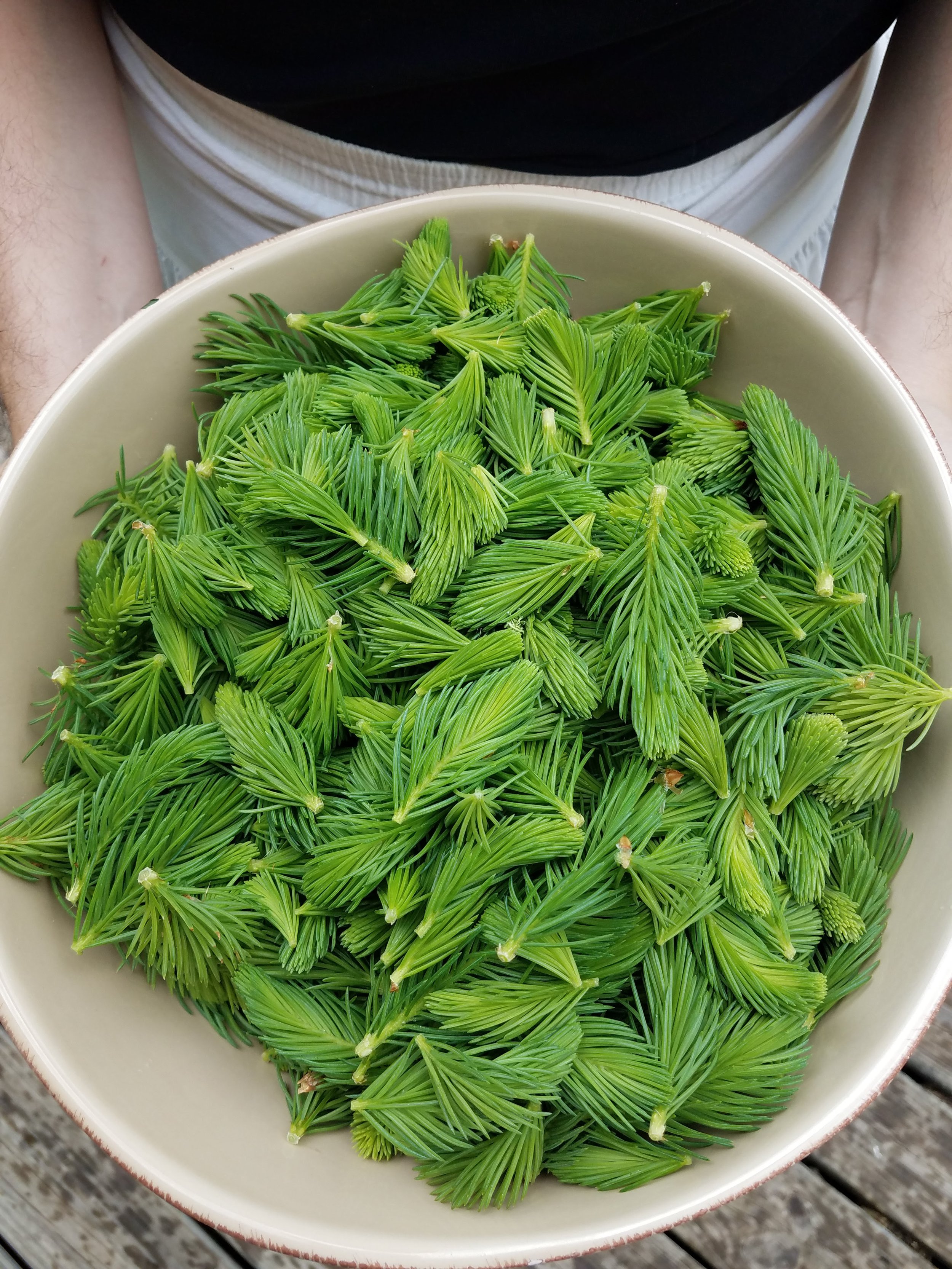
Bright green spruce tips harvested with my apprentices in 2018 for a pickle. This is the portion used to make tea, and beer.
These beers were common amongst 17th and 18th century French and English colonists in Canada who adapted the local spruce species to small beer or low alcohol beer making methods they had in Europe. This practice would eventually spread to Indigenous peoples as well and Spruce beer was given for scurvy and as a general tonic for health. The African and Caribbean influence can be seen in a later 20th century cure with the addition of rum to spruce beer and milk for tuberculosis gathered in South Carolina.
Resin
Resin and sap were mixed with either suet or lard and used in ointments for sores, especially hard to heal ones. It was also used as a general ointment for wounds to stop bleeding. Ointment like this was also used for “fall sores” or Impetigo, and for burns. The resin was also used as a pill, rolled up, which was taken as both a tonic against illness, and against the active infection of the dreaded typhoid fever. These little “pine rosin pills” were also taken for indigestion and stomach issues.
These little pills were sometimes one of the few medicines readily available to enslaved people due to the ease of finding and making them from the many pine species. The Rappahannock indigenous peoples used these hardened pine sap balls and swallowed them for kidney trouble. The resin was also mixed with baking soda and applied to painful corns on the feet. The tar made from boiling down the sap of many pine species was used as a plaster on the body for pain and would be smeared on the afflicted body part and then wrapped in clean cloth.
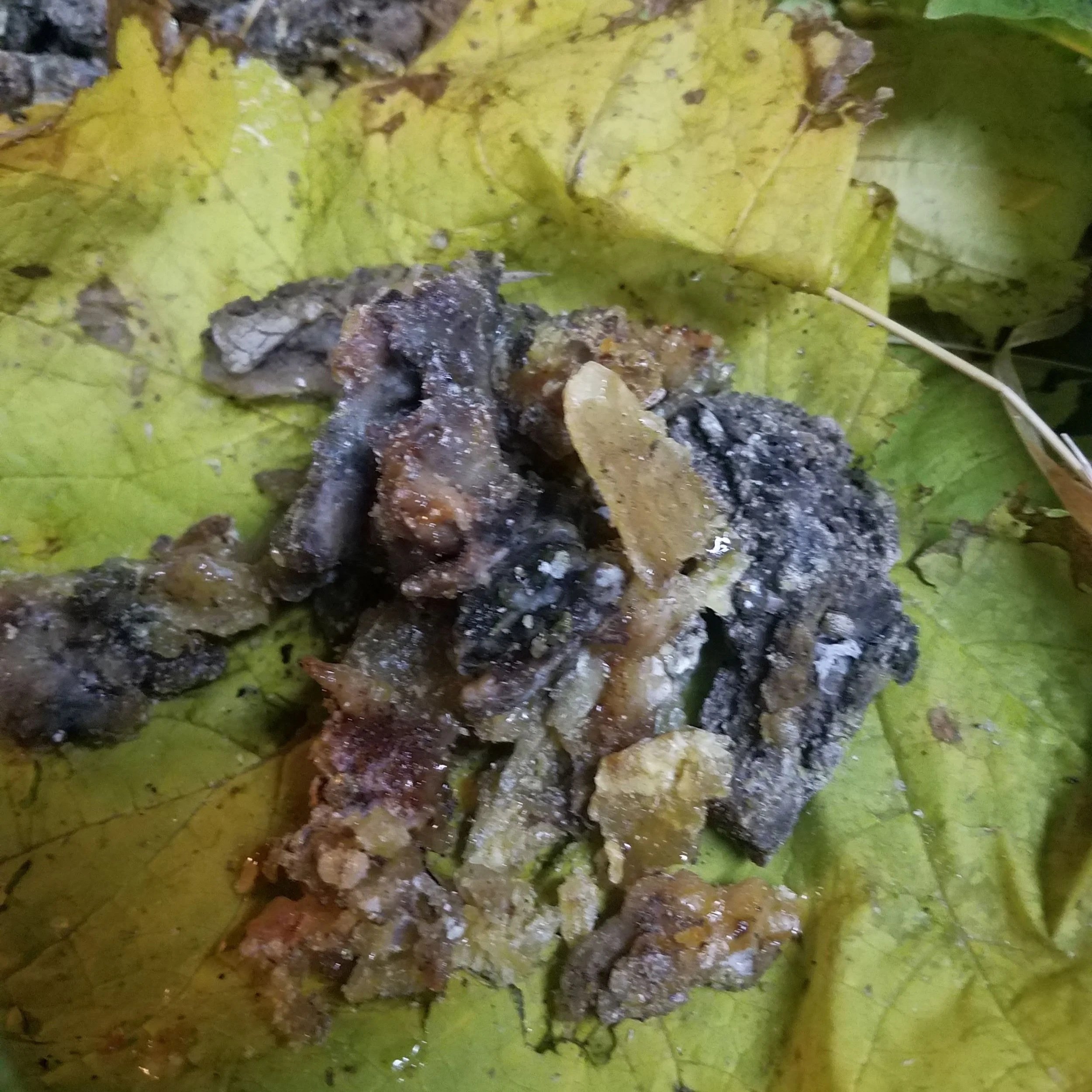
Conifer resins gathered from fallen trees in Washington State.
Wood
Evergreens often have unique knots in their wood due to their branching patterns, and these special shapes or knots made in the wood were seen as especially healing parts of the tree. If you have ever looked at a twisted up old pine, you can’t help but agree with the ancestors of this place that indeed, the fantastical shapes carved out by these tree branches appear quite magical. The knots in the wood would often be cut out of the tree and saved for medicine.
Water with pine knots soaking in it was used for typhoid fever. A remedy gathered in Rayburn country Georgia for asthma was to tincture the heartwood of a pine or a pine knot in one pint of gin until the wood turns brown, then taking a tablespoon of the tincture 2 times a day. Boiling the knots in milk was also given as a medicine for rheumatism. Pine wood was also used often as a charm for healing in Appalachia. Pinewood is sometimes called lightwood in old books, and this also especially refers to the resin filled heart wood used to help get a fire started.
Indigenous Evergreen Medicine:
It’s important when studying regional medicine traditions to familiarize ourselves with where different plant practices were born and which cultures valued those beings. These are just a small list of ways that First peoples in the Appalachian region were working with evergreen medicine. Much of these pieces of ethnobotanical lore were gathered by Euro-ancestored people so it is important to note, as a few of my Indigenous friends have told me, the uses were sometimes given wrong on purpose or changed to protect the medicine.
When we look at old books about cultures outside our own it is important to ask, who gathered this? What was their social positioning? What was it used to create? Is that information readily available to the people of the Tribe or Nation that it was gathered from? Did the publication it made benefit the people it was extracted from? What I tend to do when researching Indigenous ethnobotany is use a variety of sources and check in with my living friends about its accuracy. Indigenous written sources are always best.
This isn’t to encourage cultural appropriation of the sacred or spiritual remedies but to preserve, honor and name the ways in which the Indigenous uses of plants on Turtle Island formed the backbone of Appalachian folk medicine and how they blended with the other cultural groups to birth this unique practice. These people are still here and still living so historical remedies are given in a past tense but many of these are still practiced today.
Rappahannock peoples historically used the top branches of all pine species and mullein leaves steeped in hot water as a poultice externally on swellings. The hemlock pine (Tsuga canadenisis) was worked with by Menominee peoples for wounds and cuts as well as sores and burns due to tannin content which helps to tighten and sooth inflamed and damaged tissues.
Red spruce was used in Cherokee medicine as a tea of the boughs for measles and for coughs, colds and flus. They also used the Virginia pine extensively, which is my favorite local species to Western North Carolina (I live on Cherokee land). Decoctions and teas of the twigs and needles were given for worms, a syrup of the boughs for chronic rheumatism and the infusion, steam and oil were used in various ways as cold remedy and topically for painful joints. The root bark was boiled for topical applications for piles or hemorrhoids and thin pieces of bark chewed for diarrhea.
The antiseptic medicine of Virginia pine was used for those child-bed fevers and for swollen breasts in those breastfeeding. The tea was also used for measles and for mumps and gout. It was even used as a nervine. This pine tastes the best in my onion, almost like a mandarin orange peel flavor and it comes as no surprise to me that it is so beneficial and special. Spiritually, the wood was burned and the ashes would then be thrown on a newly kindled hearth fire after a death in a home for purification. This is a practice that is similar to many other cultures’ hearth tending after deaths. I hate the common name of scrub pine for this tree, as it is sacred.
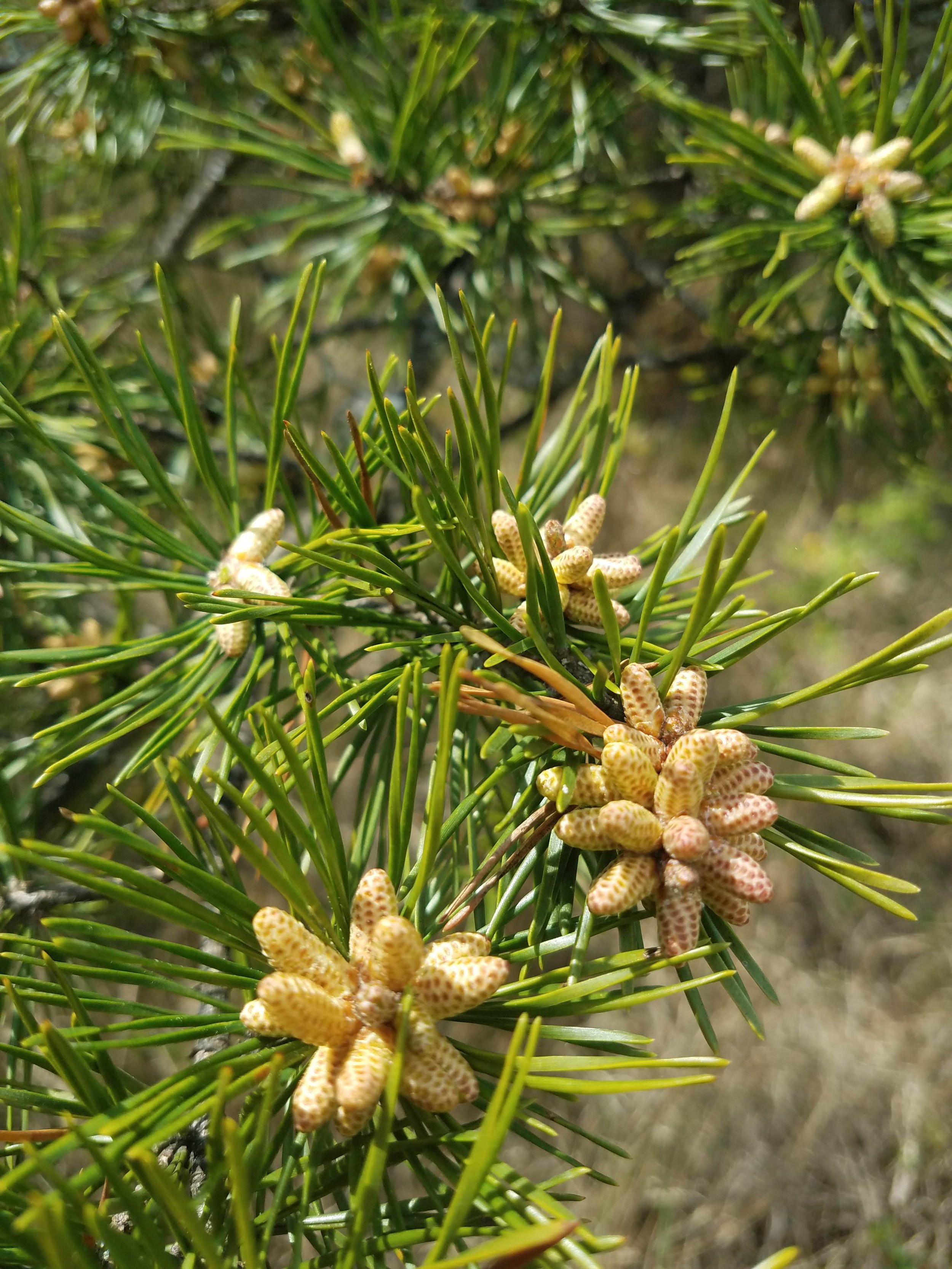
Virginia (Pinus virginiana) pine male pollen rich strobili.
Black Appalachian and Southern folk medicine
The medicinal uses of evergreens we have covered so far by 1920 would have been performed by poor people of all races. However, the special relationships between different cultural groups and how they work with herbs uniquely is always important to mention. These uses of pine were gathered from people who lived through the horrors of slavery and show a marked influence of Indigenous medicine as many people learned directly from Indigenous neighbors.
Medical care and access to it was used as a force of control during enslavement by European ancestored enslavers, leaving many enslaved people to learn quickly: relying on their own understandings of folk medicine and plant knowledge in a radically new ecosystem. The story of Black southern folk medicine is NOT a story of slavery, it is a story of creativity, intelligence, talent and mutual care amongst people subjected to the things today many of us can not even imagine in a land where many plants were new.
The pine rosin or resin pills I mentioned earlier were one of the most commonly used medicines amongst enslaved peoples in the South. They were often given with vinegar as general disease prevention and as a backache treatment. The antiseptic nature of both substances show an excellent understanding of this concept. Pine needles were also a special medicine for children and for babies sickness, colic in particular or other stomach issues.
Instead of tea the needles were chewed and eaten. Pine needles and mullein tea were often given for colds as well, both abundant and easy to find and prepare as tea. A common salve for carbuncles or infections was made from pine resin, sweet gum (Liquidambar styraciflua), beeswax, suet, and turpentine. The smoke of a pine top was also used to help a frostbite limb.
As I mentioned in my last post, I can’t recommend “The Conjuring of America” by Lindsey Stewart enough for more detailed stories of Black medicine and magic and how it has shaped America. It’s an amazing book I am currently reading.
Many people who study Black Southern folk medicine will be familiar with Caesar and his cure for snake bites with plantain (Plantago major) which freed him from slavery in the 18th century in South Carolina, but another enslaved man freed for his curing was James Pawpaw, Papaw or Papan, who created an herbal formula that was deeply helpful for a serious bacterial illness known as yaws. From a now deleted article by a historian from Colonial Williamsburg:
“James Pawpaw, born likely in Africa, developed remedies for a variety of ailments while enslaved in New Kent County [Virgina]. Among them was a treatment for yaws, a bacterial infection widespread in enslaved communities where poor conditions led to transmission. In 1729 he provided recipes for his medicines to Lt. Gov. William Gooch and the Council of State, who in exchange purchased his freedom for £50 from Frances Littlepage, of nearby Cumberland plantation, and awarded him a £20 yearly pension. Pawpaw’s treatment for yaws was widely published. Attributed to “Dr. Papa,” it appeared in Every Man His Own Doctor, British North America’s first domestic medical manual, printed by Benjamin Franklin and by others.”
The remedy:
“Take four Ounces of the Bark of the Spanish Oak, two Ounces of the middle Bark of the Pine Tree, two Ounces of the Root of the Sumack, that hears the Berries, of these Ingredients make a strong Decoction, drink it and wash the sore with it..”
This remedy shows James’ relationship to Indigenous medicine utilizing three, antiseptic, native, astringent barks and berries to help fight this difficult infection. Sumac was widely used in Southeastern Indigenous medicine for infections of the mouth and gums. It is important to note that while he was “freed” he was still under the watchful and controlling eye of the ones who wanted his remedy and any more he would find. He deserves many more essays all his own as this remedy was circulated in many books such as John Brickell’s 1737, The Natural History of North Carolina, without crediting him. The conventional treatment option at the time was mercurial salts and poisonous cures using other heavy metals, making this simple, often effective treatment all the more miraculous and accessible.
White pine is most often mentioned but what about other species?
The Hemlock pine (unrelated to the poison carrot family plant that killed Socrates) (Tsuga canadensis) is best known today as the host of the beloved reishi mushroom, and as a tree suffering from widespread death due to an invasive pest called the Wooly Adelgid. They were also used extensively in medicine and have uses with are special unto them in Appalachian folk medicine.
In Kentucky, the bark bark scraped and applied to sores and proud flesh where the healing was slow. Decoctions were made of the twigs and mixed with the twigs of my beloved spicebush and drunk very hot for influenza. The inner bark decoction is drunk for diarrhea, and the needles and twigs were drunk as tea for hoarseness, pneumonia (ginger was often added for this particular illness), to “break out the measles” and treat typhoid, as well as general colds and flus. A cough syrup from catnip, mullein, hemlock needles and twigs and rabbit tobacco would be made.
A charm for toothache:
For toothache, take a drop of the oil from a branch of the peach (Prunus persica) tree, procured by burning it with a pine knot or lightwood splinter, and drop it on the tooth.
A good charm to make a wart disappear was to rub a dead pine stick on a wart until the bark comes off. Pine is not the only anti-wart wood in Appalachian folk medicine and magic, but another way to charm them off using pine was to cut as many notches in a piece of pine wood as you have warts. Cut the warts till they bleed, and cover the notches with the blood. Hide the stick under the back doorstep and the warts will go away.
As in many charms in the mountains, it works best if you forget about the stick and don’t think about it. Still yet another charm to remove a wart is to stick nine straight pins into it, and secretly stick them into a pine tree, and the wart will disappear. This one uses contagion magic to transfer the warts to the knotty pine through the pin and the number 9 often used in Appalachian folk magic for it is 3 x 3, the Father, Son and the Holy Ghost.
Some evergreen wood has taboos around it. It is said that if you burn spruce pine wood, the house will get burned. Other woods that are bad luck to burn include sassafras, apple and elderberry. Other pines were burned for lightwood (to start a fire) and to smoke for its embalming effects on a corpse at a wake.
It is said that the pine trees minister to a “diseased mind” or one troubled with bad thoughts in Appalachian folk medicine historically. From Frank C. Brown’s Collection of North Carolina Folklore, Mrs. Maude Minish Sutton, Lenoir, Caldwell county circa 1950:
"You can take the achinest heart on earth into a big pine woods and let hit jist drink in the smell and singin' of the trees and crunch the needles underfoot, and you'll come out feeling better. I believe God likes the pine trees best of all his trees."
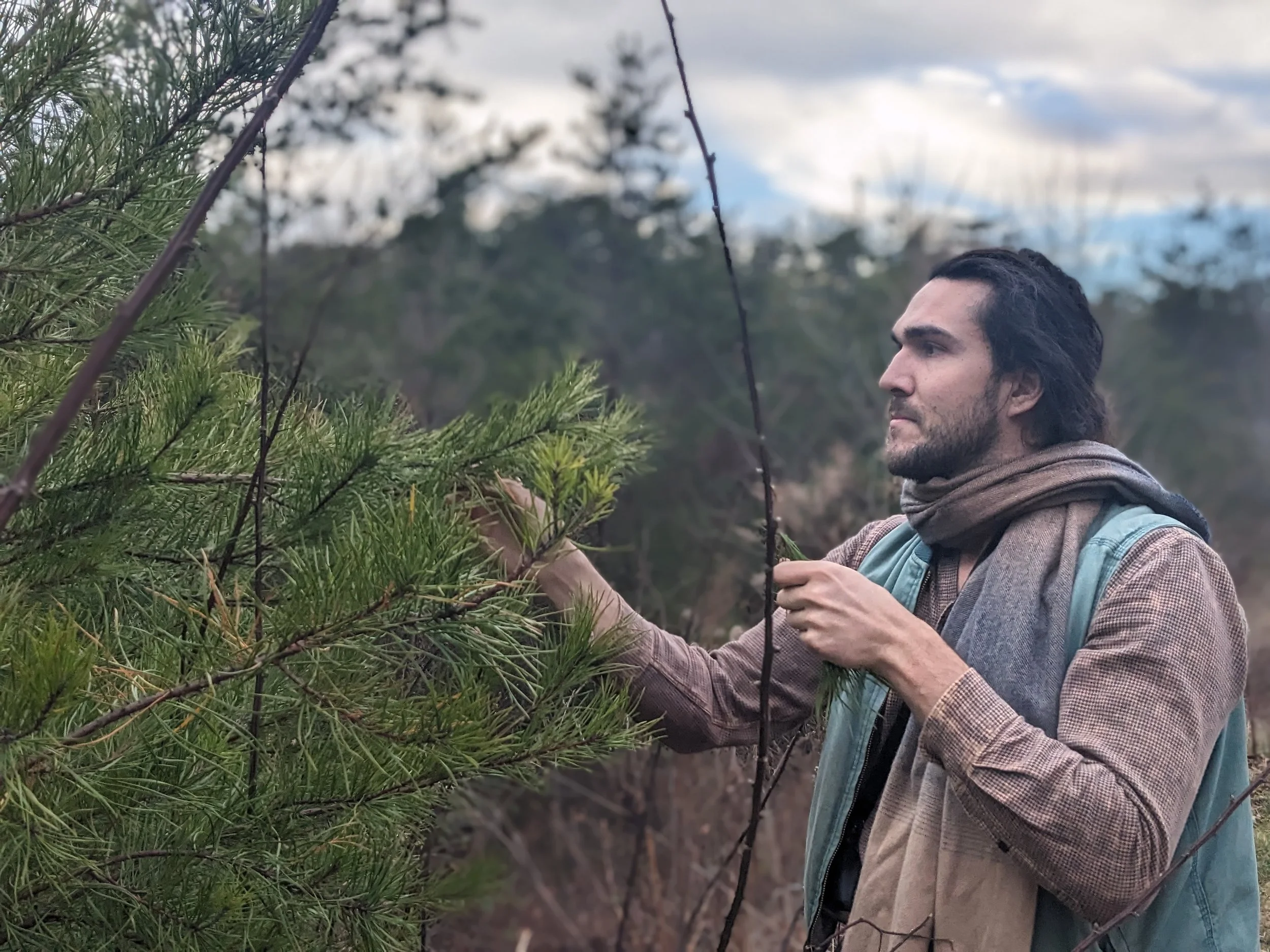
My partner Daniel harvesting Virginia pine tips.
Charming Pine…
Appalachian folk charms and folklore of the evergreens gathered from Frank C Brown’s Collection of North Carolina Folklore:
If you find a hairpin, and hang it on a pine tree, you will have a letter by the next mail.
You can put the girl from his mind, in case you have trouble about getting the hair around his neck, by taking a lock of her hair and putting it in a split in a sliver from a lightning-
struck white pine, and by then throwing the pine in running water. She will go as far as the water runs.Cut your pine wood in the new of the moon, if you want it to be light.
If a baby has thrush, a man who has never seen his father may walk around a pine tree several times, blow into the baby's mouth for seven days and they will be cured.
To cure a backache, dig up some pine roots in a road where there has never been any corpse, burn the roots, and then apply rosin to your back.
To cure the chills: Take a cord and tie it around the body, and then take it and tie the other end to a pine tree. Then sleep one night with the cord fixed this way, and the chills will leave.
For chills and fever, tie a piece of yarn taken from your stocking around a pine tree
then walk around the tree three times a day for nine days.A cure for influenza is to skin off the black pine into where the white inner bark appears and then chip out the soft tissue and soak it in warm water for from three to five hours. When the bark has soaked the prescribed amount of time, take in small quantities. The tree, however, must be skinned on the north side. (Many charms and remedies in Appalachian and Southern folk practice require particular directional bark peeling. This comes from Indigenous medicine ways).
Now that we have dug into the history of the medicine, how does evergreen work today in the living practice of Appalachian folk medicine? We will explore that in the next essay.
Bless the pines and spruces and firs, the cedars the cypress and the lightwood.
Works Cited…
Banks, William H., Jr., and Steve Kemp (2004). Plants of The Cherokee: Medicinal, Edible, and Useful Plants Of The Eastern Cherokee Indians. Gatlinburg, TN : Great Smoky Mountains Association.
Bolyard, Judith L. (1981). Medicinal plants and home remedies of Appalachia. Springfield, Thomas.
Covey, H. C. (2007). African-American Slave Medicine: Herbal and non-Herbal Treatments. United Kingdom: Bloomsbury Academic.
Hamel, Paul B. and Mary U. Chiltoskey. (1975). Cherokee Plants and Their Uses -- A 400 Year History. Sylva, N.C. Herald Publishing Co.
Moss, K. K. (2021). Southern Folk Medicine, 1750-1820. United States: University of South Carolina Press.
Stewart, L. (2025). The Conjuring of America: Mojos, Mermaids, Medicine, and 400 Years of Black Women's Magic. United States: Grand Central Publishing.
